Google Ads vs SEO: Which One Should Your Business Invest In First?
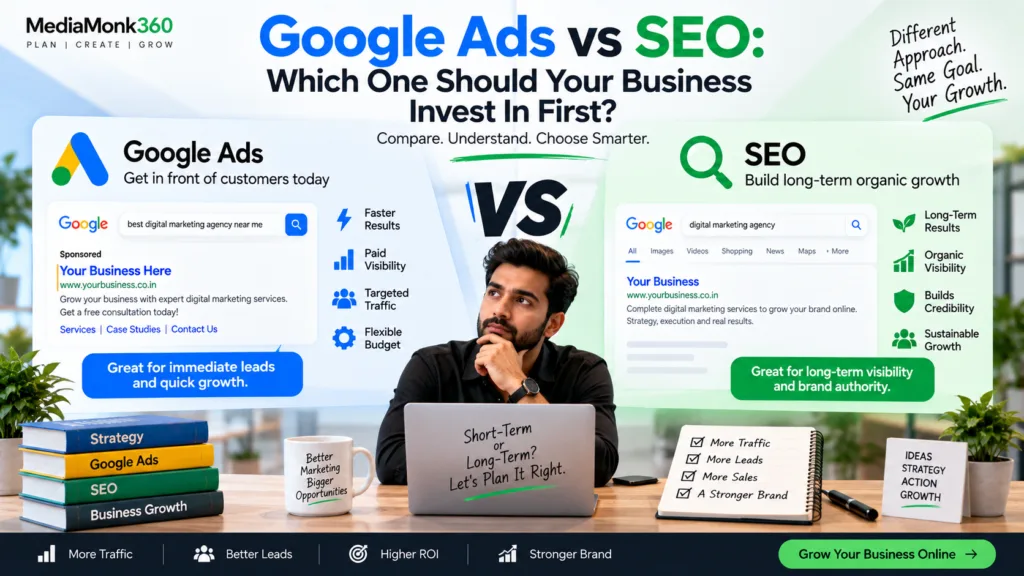
If you are trying to grow a business online, two channels usually come up very early in the conversation: Google Ads and SEO.
Both can help your business appear when potential customers search on Google. But they work in very different ways.
With Google Ads, you pay for advertising space and can potentially start reaching relevant searchers soon after your campaign becomes eligible to run.
With SEO, you improve your website and content so that your pages can earn organic visibility in search results over time.
This creates a common question for business owners:
Should I invest in Google Ads first, or should I focus on SEO?
There is no universal answer.
The right choice depends on how quickly you need results, your competition, your available budget, the value of each customer and the stage of your business.
For many businesses, the strongest long-term strategy is eventually to use both. But if your budget is limited and you have to choose one first, understanding the difference can help you make a much better decision.
What Is the Difference Between Google Ads and SEO?
Google Ads and SEO both target search demand, but they approach it from different directions.
Google Ads is a paid advertising channel. Businesses create campaigns and advertisements that can appear in eligible Google search results and other Google advertising placements depending on the campaign type.
SEO is the process of improving a website’s technical foundation, content, relevance and overall search visibility so that its pages can appear organically.
The most obvious difference is how visibility is obtained.
With Google Ads, you pay to participate in an advertising auction and your ads can appear when the campaign meets the relevant conditions.
With SEO, you are working toward earning organic visibility rather than paying Google for each organic click.
That difference has major implications for budget, speed, sustainability and strategy.
Google Ads: Faster Access to Search Demand
One of the biggest reasons businesses choose Google Ads is speed.
Imagine you have just launched a new business website and offer a service that people are already actively searching for.
Your website may not yet have strong organic visibility.
SEO can take time because search engines need to discover, process and evaluate your pages, while your website also needs to build relevance and authority.
Google Ads can provide a way to enter the paid search environment much sooner.
This can be especially useful when a business has an immediate sales target, a new service to promote or a seasonal opportunity.
However, faster visibility does not automatically mean profitable results.
A campaign can generate clicks without generating enough qualified leads or sales.
That is why Google Ads should always be connected to a clear conversion goal.
The Cost of Google Ads
Google Ads requires an ongoing advertising budget.
The exact cost varies significantly depending on the industry, competition, location, search demand, targeting and campaign structure.
A highly competitive commercial keyword can cost substantially more than a less competitive search.
This means businesses should not decide their Google Ads budget simply by looking at what another company spends.
Instead, think about the economics of your own business.
If an average customer generates ₹50,000 in revenue, your acceptable acquisition cost may be very different from a business where an average transaction is worth ₹500.
The important question is not simply:
“How much does a Google Ads click cost?”
It is:
“How much does it cost to acquire a customer, and does that acquisition cost make business sense?”
SEO: Building Organic Search Visibility
SEO takes a different approach.
Instead of paying for each advertisement click, you invest in improving the website and creating useful content that can earn organic visibility.
This can involve technical SEO, keyword research, search intent analysis, content development, internal linking, local SEO, website performance and other areas that contribute to a stronger search presence.
The major advantage is that successful organic visibility can continue bringing visitors without a direct advertising charge for every click.
But SEO is not free.
There are costs associated with strategy, content creation, technical improvements, development, tools and ongoing optimization.
The difference is that the investment is generally going into the asset and visibility of the website itself, rather than directly buying advertising placements.
SEO Usually Takes More Time
SEO is generally a longer-term strategy.
A new website may need considerable time to establish organic visibility, especially in a competitive industry.
Even when a page is well optimized, there is no guarantee that it will rank for a particular keyword or reach a specific position.
That is why businesses should be cautious about agencies promising guaranteed Google rankings.
SEO works best when viewed as a process of building search visibility and improving the quality and usefulness of the website over time.
Google Ads vs SEO: Which Gives Faster Results?
If speed is the main priority, Google Ads generally has the advantage.
A properly configured campaign can begin generating paid search visibility much sooner than a new SEO strategy can establish strong organic rankings.
This makes Google Ads particularly useful for businesses that need to generate enquiries quickly.
For example, a new local service business may want to test whether people are willing to enquire about a particular service before investing heavily in long-term content.
Google Ads can provide useful market feedback because the business can observe which searches generate clicks and conversions.
SEO, on the other hand, is better suited to building a long-term search presence.
The two approaches therefore serve different time horizons.
Which Is Cheaper: Google Ads or SEO?
This question is more complicated than it first appears.
Google Ads has a direct advertising cost. You set a budget and pay according to the campaign’s advertising activity.
SEO does not generally involve paying Google for organic clicks, but producing and maintaining high-quality SEO work requires investment.
You may need writers, SEO specialists, developers, designers, technical tools and time.
Therefore, it would be misleading to say that SEO is simply “free traffic.”
Organic traffic can be extremely valuable, but building that traffic requires work.
The more useful comparison is customer acquisition cost and business value rather than simply the cost of a click.
Which Is Better for Long-Term Growth?
For long-term search visibility, SEO has a significant strategic advantage.
A useful article or well-optimized service page can continue attracting organic search traffic long after its initial publication.
A strong website can also build topical coverage across multiple related searches.
Google Ads, by contrast, is directly connected to advertising spend.
When you stop running your campaigns, your paid search visibility generally stops as well.
This does not make Google Ads a bad investment.
It simply means that Google Ads and SEO create value in different ways.
Google Ads can help you buy immediate visibility.
SEO can help you build owned search visibility over time.
What About Lead Generation?
Both channels can generate leads.
The quality of those leads depends heavily on targeting, search intent, advertisements, landing pages, content and conversion experience.
Google Ads can be particularly useful for high-intent searches.
Someone searching for:
“digital marketing agency for small business”
may already be evaluating service providers.
An SEO article targeting a broad informational topic such as:
“what is digital marketing?”
may attract a larger educational audience, but that visitor may not yet be ready to buy.
This doesn’t mean informational SEO traffic has no value.
It can help businesses build awareness and introduce potential customers to their brand earlier in the decision-making process.
The key is understanding where each visitor is in the buying journey.
Google Ads Is Useful for Testing Demand
One of the less obvious advantages of Google Ads is its ability to provide relatively quick feedback.
Suppose you are considering launching a new service.
You can build a focused campaign around relevant commercial searches and send visitors to a dedicated landing page.
If the campaign attracts relevant searches but receives very few enquiries, that tells you something.
Perhaps the offer needs improvement.
Perhaps the landing page isn’t convincing.
Perhaps the search volume is limited.
Perhaps the price or positioning isn’t competitive.
That information can be valuable even when the campaign doesn’t immediately produce the desired result.
SEO can also provide valuable search data, but it generally takes longer to accumulate meaningful visibility.
SEO Is Valuable for Building Brand Authority
SEO can do more than generate traffic.
A well-developed website can become a useful resource around a specific subject.
For example, a digital marketing agency can publish detailed content around SEO, Google Ads, Meta Ads, content marketing, website development and other areas relevant to its customers.
Over time, this creates a broader digital presence.
Someone may first discover the company through an educational article and later return when they need a service.
This is one reason SEO should not always be evaluated only on immediate lead generation.
Some organic content contributes to the earlier stages of the customer journey.
What Should a New Business Choose?
For a new business with limited organic visibility and an immediate need for enquiries, Google Ads can be a practical starting point.
The business can begin with a controlled budget, focus on high-intent searches and measure actual enquiries or sales.
At the same time, it makes sense to start building the SEO foundation.
Waiting several months before doing anything about SEO can create unnecessary delays.
Your website structure, service pages, technical SEO and content strategy can begin developing while Google Ads handles more immediate demand.
This creates a combination of short-term and long-term thinking.
What Should an Established Business Choose?
An established business with existing organic traffic may have a different priority.
If the company already receives valuable organic visitors, strengthening SEO can create additional long-term opportunities.
Google Ads can then be used strategically to cover important commercial searches, promote specific offers or reach areas where organic visibility is still weak.
For established businesses, the question often becomes less about choosing one channel and more about determining where each channel can create the greatest incremental value.
What If Your Competitors Are Using Both?
In competitive markets, relying on only one channel can limit your visibility.
Imagine a competitor appearing through Google Ads at the top of the page while also ranking organically below the advertisements.
They have multiple opportunities to be seen.
A business using both channels can similarly occupy more of the search landscape.
This does not mean you should spend money simply because competitors are doing it.
Your strategy should still be based on your own economics and customer behaviour.
But it does demonstrate why Google Ads and SEO can complement each other rather than compete with each other.
Google Ads and SEO Can Share Data
Another advantage of using both channels is that insights from one can improve the other.
Google Ads can reveal commercial search terms that generate meaningful engagement or conversions.
Those insights can inform SEO content planning.
Similarly, SEO can reveal topics and queries where your website has strong organic visibility.
Google Ads can potentially be used to strengthen visibility around important commercial searches.
This creates a feedback loop where paid and organic search inform one another.
So, Which Should You Invest In First?
If your business needs faster visibility and immediate lead-generation opportunities, Google Ads may be the more appropriate first investment.
If your priority is building sustainable organic search visibility and reducing long-term dependence on paid traffic, SEO deserves early attention.
If you have the resources, the strongest approach is usually to build both in parallel, with different expectations for each channel.
Use Google Ads to capture existing demand now.
Use SEO to build a stronger organic presence for the future.
The exact balance depends on your business model.
A Practical Decision Framework
If your website is new, your organic visibility is limited and you need customers soon, begin with a controlled Google Ads campaign while building your SEO foundation.
If your business already has strong organic traffic and you have time to invest in long-term growth, increasing your SEO investment may provide greater strategic value.
If your market is highly competitive, using both channels can give you more opportunities to reach potential customers.
And if your budget is extremely limited, start by understanding where your highest-value customers come from before committing to a large advertising or content budget.
The goal is not to choose the channel that sounds better.
The goal is to choose the channel that best matches your business stage, customer journey and financial model.
Final Thoughts
Google Ads and SEO are not really enemies.
They solve different problems.
Google Ads can help businesses access search demand quickly and test commercial opportunities. SEO takes longer but can build valuable organic visibility and strengthen the website as a long-term marketing asset.
For many businesses, the smartest strategy is not Google Ads versus SEO.
It is Google Ads plus SEO, used for different purposes.
Use paid search when speed, testing and immediate demand capture matter.
Invest in SEO when you want to build sustainable visibility, useful content and long-term search equity.
The right strategy is ultimately the one that connects marketing spend with real business outcomes.
Don’t ask only which channel gets more traffic. Ask which channel brings the right customers, at a cost your business can support, while helping you build a stronger business for the future.
Questions, Clearly Answered.
Get straightforward answers to common questions around SEO, advertising, social media, content and digital growth.
Results depend on the channel, competition, website condition, budget and business objectives. SEO generally needs consistent work over time, while paid campaigns can generate measurable data much faster.
SEO helps businesses build organic visibility, useful content assets and sustainable search presence. It also supports visibility across modern search experiences and AI-powered discovery.
SEO focuses on organic visibility, while Google Ads uses paid placements to reach selected searches and audiences. Businesses may use either channel or combine both depending on their goals and timelines.
Yes. Social media can support awareness, engagement, lead generation and remarketing when content, targeting, creative and conversion paths are aligned.
GEO refers to Generative Engine Optimization and AEO refers to Answer Engine Optimization. Both focus on making information easier for modern search and answer systems to understand and surface.
The decision depends on business objectives, competition, budget, sales cycle, audience and desired timeline. Paid campaigns can provide faster testing, while SEO builds organic visibility over time.
Explore More Insights
Practical insights on SEO, advertising, content, social media and digital business growth.
Google Ads for Small Businesses: How to Start Without Wasting Your Budget
How to Optimize Your Website for AI Search, LLMs and Google AI Overviews
GEO vs AEO vs SEO: What Businesses Need to Know About AI Search
How to Build an SEO Strategy That Actually Brings Business Leads
SEO for Small Businesses in India: A Practical Guide to Getting More Organic Traffic
Digital Services Built Around Growth
From websites and apps to search, paid media, content and creative — everything you need to build a stronger digital presence.
Web Development
Fast, responsive and conversion-focused websites.
App Development
Modern mobile apps designed around your users.
SEO / GEO / AEO
Search visibility across Google and AI discovery.
Google Ads / PPC
Targeted campaigns focused on qualified traffic.
Meta Ads
Creative campaigns built for reach and leads.
Social Media Management
Consistent social content that builds your brand.
Content Writing
Useful, search-friendly content that earns attention.
Graphic Design
Clean visual systems for stronger brand communication.
Ready to Turn Your Digital Presence Into Growth?
Let's create a focused digital strategy for your business and turn ideas into measurable results.
Talk to MediaMonk360