Google Ads for Small Businesses: How to Start Without Wasting Your Budget
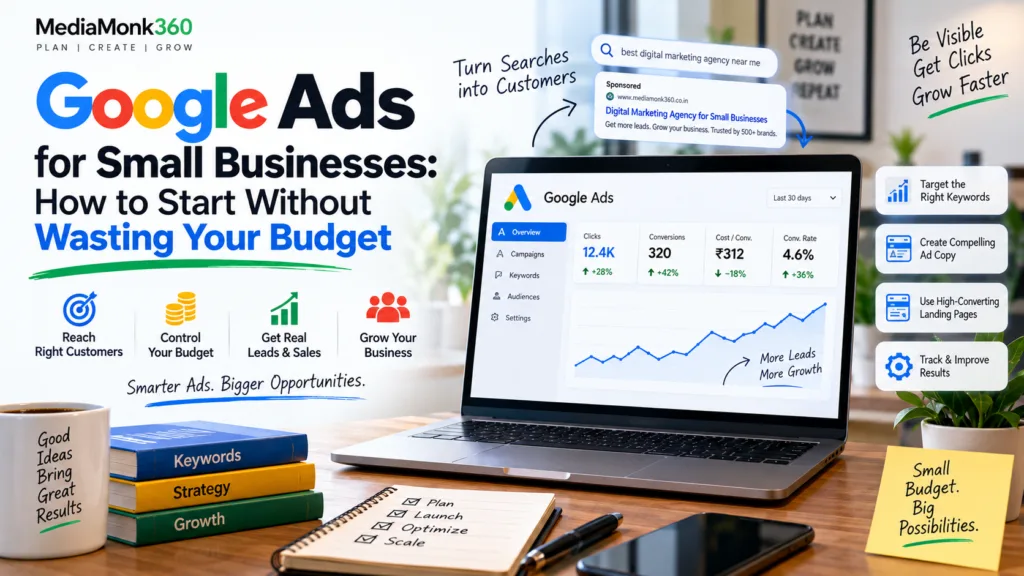
For a small business, Google Ads can be one of the fastest ways to put your products or services in front of people who are already searching for them.
But there is an important difference between running Google Ads and running Google Ads profitably.
It is possible to spend money every day and receive clicks without generating enough enquiries, sales or customers to justify the investment. This is why many small businesses become frustrated with PPC advertising. The problem is often not Google Ads itself, but the way the campaign has been planned, targeted and measured.
A successful Google Ads campaign starts before the first advertisement goes live. You need to understand what your customers search for, which searches have commercial value, where you want your ads to appear, what happens after someone clicks and what a worthwhile conversion means for your business.
Google itself describes the campaign budget as an important tool for controlling how much you spend and balancing advertising costs with performance goals.
For a small business, the objective should not be to spend as much as possible.
The objective should be to spend deliberately, learn from the data and scale only when the campaign demonstrates that additional spending can make business sense.
What Are Google Ads?
Google Ads is Google’s advertising platform that allows businesses to promote products and services across Google’s advertising ecosystem.
For small businesses, Search campaigns are particularly useful because they can reach people when they are actively looking for a solution.
For example, someone searching for:
“best website development company near me”
has a different level of commercial intent from someone searching:
“what is website development?”
The first person may already be considering a service provider, while the second is primarily looking for information.
This difference in intent is one of the most important concepts to understand before spending money on PPC.
Your advertising budget should be concentrated on searches that are relevant to what your business actually sells and to the customers you want to acquire.
Why Google Ads Can Work Well for Small Businesses
One of the biggest advantages of Google Ads is that it can connect businesses with existing demand.
With organic SEO, it can take time for a new page or website to build search visibility. Google Ads can provide paid visibility much sooner, provided the campaign is properly configured and eligible to serve.
Imagine a local business that provides air-conditioner repair.
A person searching for:
“AC repair service near me”
may have an immediate need.
An advertisement that appears at the right time can potentially generate a call or enquiry.
That is very different from interrupting someone who is casually browsing social media.
This doesn’t mean every Google Ads click is valuable. It means search advertising gives businesses an opportunity to reach users based on active search intent.
The challenge is making sure the campaign captures the right intent, rather than simply generating traffic.
Start With a Clear Business Goal
Before creating a campaign, decide what you actually want Google Ads to accomplish.
A campaign designed to generate phone calls should not be evaluated in exactly the same way as a campaign designed to sell products online.
Similarly, a business looking for qualified enquiries needs to think differently from a business trying to increase website traffic.
For most small service businesses, the useful outcome may be a qualified lead, phone call, consultation request or WhatsApp enquiry.
For an ecommerce business, it may be a completed purchase and the revenue generated from that purchase.
This distinction matters because Google Ads provides many metrics, but not all metrics represent business value.
A campaign can receive hundreds of clicks and still perform poorly if those visitors never become customers.
Google recommends using conversion data to understand what is valuable to a business and using conversion tracking to guide campaign optimization.
Know What a Valuable Conversion Means
A conversion should represent an action that matters to your business.
For one company, that could be a purchase.
For another, it could be a qualified enquiry.
For a local service provider, a phone call lasting several minutes might be more valuable than someone simply visiting the homepage.
The more accurately you define your conversion, the better you can judge whether your advertising budget is working.
How Much Should a Small Business Spend on Google Ads?
There is no universal Google Ads budget that works for every small business.
A reasonable budget depends on factors such as your industry, location, average customer value, competition, expected cost per click and the number of conversions you need.
Instead of asking:
“What is the minimum amount I can spend?”
a better question is:
“What level of investment gives me enough data to evaluate whether this campaign can produce profitable results?”
For example, a local business might begin with a controlled daily budget rather than immediately committing a large monthly amount.
The initial stage should be treated as a learning period.
You want enough activity to understand which searches, advertisements and landing pages are producing meaningful results.
At the same time, the budget should be small enough that early mistakes do not become expensive.
Google uses an average daily budget to help advertisers control campaign spending. Actual daily spending can vary, while Google’s monthly charging limits are based on the average daily budget.
The exact amount should therefore be decided according to the economics of your business rather than copying another company’s budget.
Choose the Right Keywords
Keywords are one of the foundations of a Search campaign.
Suppose you operate a web development company.
A keyword such as:
“website development company”
may be commercially relevant.
But a search such as:
“what is a website”
is likely to have very different intent.
The goal is not to collect the largest possible keyword list.
The goal is to build a keyword set that represents the searches your potential customers are actually making.
Google Ads currently provides three primary keyword match types for Search campaigns: broad match, phrase match and exact match. Google explains that these match types control how closely keywords relate to the searches that can trigger ads.
For a new small-business campaign, understanding the differences is important because your targeting choices can influence both reach and relevance.
Don’t Assume Every Search Is Valuable
A keyword can appear relevant while still producing poor-quality traffic.
For example, a company selling premium web development services may not want to pay for searches from people looking for a free website builder, tutorials or jobs.
This is where search-term analysis becomes important.
You need to look beyond the keywords you entered and understand the actual searches that triggered your advertisements.
Use Negative Keywords to Reduce Wasted Spend
Negative keywords are one of the most useful tools for controlling irrelevant traffic.
Suppose you provide paid web development services but do not offer free website creation.
If your advertisements start appearing for searches related to “free website development,” those clicks may not be useful to your business.
Adding appropriate negative keywords can help prevent ads from showing for searches that are not relevant to your offer.
Google explains that negative keywords allow advertisers to exclude search terms and focus advertising on searches that matter to their customers.
The search terms report can also help you discover new negative keyword opportunities because it shows the actual searches that triggered your advertisements.
This is one reason you should not simply launch a campaign and leave it untouched.
The search data generated after launch can tell you what people are actually looking for.
Write Ads That Match the Search
Your advertisement should make sense in the context of the search that triggered it.
If someone searches for:
“Google Ads agency for small business”
the advertisement should clearly communicate what the business offers.
A vague advertisement may receive impressions but fail to attract the right clicks.
A relevant advertisement sets better expectations before the visitor reaches the website.
Your messaging should also connect naturally with the landing page.
If the advertisement promises a specific service but sends visitors to a generic homepage with no obvious information about that service, the user experience becomes weaker.
Relevance Matters More Than Clever Copy
Google Ads is not a competition to write the most creative headline.
The advertisement needs to be clear.
A potential customer should quickly understand what you offer and why the page may be relevant to their search.
For example, a local SEO agency might communicate its location, service and primary value proposition rather than using vague statements such as “Take Your Business to the Next Level.”
Clarity usually gives the visitor a better reason to continue.
Don’t Send Every Ad to Your Homepage
One of the common mistakes small businesses make is sending every advertisement to the homepage.
The homepage may explain the entire business, but it isn’t always the best destination for a specific search.
Imagine someone searches for:
“Google Ads management for small businesses.”
If the advertisement sends them to a dedicated Google Ads service page explaining the service, process and enquiry options, the experience is more relevant.
If the same person lands on a homepage where they need to search through several sections to find Google Ads information, some of the value of the click may be lost.
A dedicated landing page can therefore make sense when the campaign has a clear service or product focus.
Location Targeting Matters for Local Businesses
If your business serves a particular city or region, geographic targeting deserves careful attention.
A local business does not necessarily want to spend its budget showing ads to people thousands of kilometres away.
Suppose a salon operates in Nagpur.
If most customers need to physically visit the salon, targeting people searching from completely unrelated locations can waste advertising spend.
The appropriate geographic setup depends on the business model.
An ecommerce company may sell throughout India.
A local clinic may serve only nearby customers.
A B2B software company may serve businesses across multiple countries.
The targeting should reflect the actual service area.
Don’t Change Everything Every Day
New advertisers sometimes make too many changes too quickly.
They change keywords, advertisements, budgets and bidding settings after only a small amount of data.
That can make it difficult to understand what actually caused performance to change.
Campaign optimization should be based on meaningful data and a clear hypothesis.
If irrelevant searches are appearing, review search terms and negative keywords.
If people are clicking but not converting, examine the landing page and conversion experience.
If a campaign is generating profitable conversions but budget is limiting additional demand, increasing the budget may be worth testing.
Google notes that campaigns running out of budget while producing conversions at a reasonable CPA may have an opportunity to capture additional demand by increasing budget.
The key is to make changes based on evidence rather than guesswork.
Track Conversions Before Judging Performance
Clicks and impressions are useful, but they do not tell the complete story.
Imagine two campaigns.
Campaign A receives 500 clicks and generates two qualified enquiries.
Campaign B receives 150 clicks and generates eight qualified enquiries.
Looking only at traffic would make Campaign A appear stronger.
Looking at actual business outcomes tells a different story.
This is why conversion tracking is so important.
Google recommends using conversion rate, conversion value and related performance metrics to understand the business impact of Search campaigns.
For a lead-generation campaign, make sure important actions such as enquiry submissions, calls or other valuable actions can be measured appropriately.
Understand Cost Per Lead
Cost per lead, or CPL, can be a useful metric for service businesses.
For example, if you spend ₹20,000 on advertising and generate 20 qualified enquiries, the average advertising cost per enquiry is ₹1,000.
But even that number does not tell you whether the campaign is profitable.
The quality of those leads matters.
If only one of the 20 enquiries becomes a customer, the business needs to evaluate the actual customer acquisition cost and customer value.
This is why a campaign should be evaluated beyond the first conversion.
The ultimate question is whether advertising is producing enough business value to justify the investment.
Google Ads Should Work With Your Website
A strong advertisement cannot compensate for a poor landing page.
When someone clicks an ad, they should immediately understand where they are and what they can do next.
The page should match the advertisement and search intent.
It should explain the relevant service clearly and make the next action straightforward.
For a lead-generation business, that might mean a simple enquiry form, phone number or WhatsApp option.
For an ecommerce business, it might mean a clear product page with pricing, product information and an easy purchase process.
The landing page is part of the advertising experience.
Treating Google Ads and the website as two completely separate activities can therefore lead to missed opportunities.
When Should You Increase Your Google Ads Budget?
Increasing the budget should come after you understand what is working.
If a campaign consistently produces relevant conversions at an acceptable cost, additional budget may allow it to capture more demand.
But increasing spend simply because you want more traffic can be risky.
Suppose your campaign spends ₹10,000 and generates good-quality leads.
You could test a higher budget gradually and observe whether the additional spend maintains acceptable performance.
If performance deteriorates significantly, the problem may not simply be the budget. It could indicate limited demand, higher-cost searches, weak targeting or other campaign constraints.
Google provides budget simulation and planning tools that can help advertisers estimate potential changes when adjusting budgets.
Common Google Ads Mistakes Small Businesses Should Avoid
The biggest mistake is launching campaigns without knowing what success means.
Another common problem is targeting overly broad or irrelevant searches and failing to review search terms.
Sending all traffic to the homepage can also weaken the connection between the advertisement and the visitor’s intent.
Small businesses can also waste money by focusing on clicks rather than qualified conversions.
Perhaps the most expensive mistake is treating Google Ads as a set-and-forget activity.
Search behaviour changes. Competitors change their advertisements. Costs change. New search terms appear.
A campaign needs regular review and informed optimization.
A Simple Google Ads Approach for a Small Business
A practical starting process is relatively straightforward.
First, define the product or service you want to advertise and the customer you want to reach.
Then research the searches associated with that offer and group related keywords according to intent.
Create focused campaigns and ad groups so that the advertisements remain relevant to the searches.
Build or select landing pages that directly match those advertisements.
Set a controlled budget that fits the economics of your business.
Before launch, configure meaningful conversion tracking.
Once the campaign is active, review the actual search terms, conversions, cost per conversion and landing-page performance.
Use the data to remove irrelevant traffic, improve advertisements and strengthen the parts of the campaign that are producing useful business results.
Only after the campaign demonstrates consistent performance should you think seriously about scaling.
Final Thoughts
Google Ads can be a powerful growth channel for small businesses, but it should not be treated as a machine where putting in more money automatically produces more customers.
The strongest campaigns start with a clear business objective.
They target relevant customer intent, use appropriate keywords, control irrelevant searches, connect advertisements with useful landing pages and measure conversions instead of focusing only on clicks.
Most importantly, small businesses should start with discipline.
You don’t need the biggest budget in your market.
You need a campaign where the money you spend is being directed toward searches, visitors and actions that have a genuine connection to your business.
Once you understand what works, you can improve it.
And once you can consistently demonstrate that additional advertising spend creates additional business value, you can scale with much greater confidence.
Questions, Clearly Answered.
Get straightforward answers to common questions around SEO, advertising, social media, content and digital growth.
Results depend on the channel, competition, website condition, budget and business objectives. SEO generally needs consistent work over time, while paid campaigns can generate measurable data much faster.
SEO helps businesses build organic visibility, useful content assets and sustainable search presence. It also supports visibility across modern search experiences and AI-powered discovery.
SEO focuses on organic visibility, while Google Ads uses paid placements to reach selected searches and audiences. Businesses may use either channel or combine both depending on their goals and timelines.
Yes. Social media can support awareness, engagement, lead generation and remarketing when content, targeting, creative and conversion paths are aligned.
GEO refers to Generative Engine Optimization and AEO refers to Answer Engine Optimization. Both focus on making information easier for modern search and answer systems to understand and surface.
The decision depends on business objectives, competition, budget, sales cycle, audience and desired timeline. Paid campaigns can provide faster testing, while SEO builds organic visibility over time.
Explore More Insights
Practical insights on SEO, advertising, content, social media and digital business growth.
Google Ads vs SEO: Which One Should Your Business Invest In First?
How to Optimize Your Website for AI Search, LLMs and Google AI Overviews
GEO vs AEO vs SEO: What Businesses Need to Know About AI Search
How to Build an SEO Strategy That Actually Brings Business Leads
SEO for Small Businesses in India: A Practical Guide to Getting More Organic Traffic
Digital Services Built Around Growth
From websites and apps to search, paid media, content and creative — everything you need to build a stronger digital presence.
Web Development
Fast, responsive and conversion-focused websites.
App Development
Modern mobile apps designed around your users.
SEO / GEO / AEO
Search visibility across Google and AI discovery.
Google Ads / PPC
Targeted campaigns focused on qualified traffic.
Meta Ads
Creative campaigns built for reach and leads.
Social Media Management
Consistent social content that builds your brand.
Content Writing
Useful, search-friendly content that earns attention.
Graphic Design
Clean visual systems for stronger brand communication.
Ready to Turn Your Digital Presence Into Growth?
Let's create a focused digital strategy for your business and turn ideas into measurable results.
Talk to MediaMonk360