How to Optimize Your Website for AI Search, LLMs and Google AI Overviews
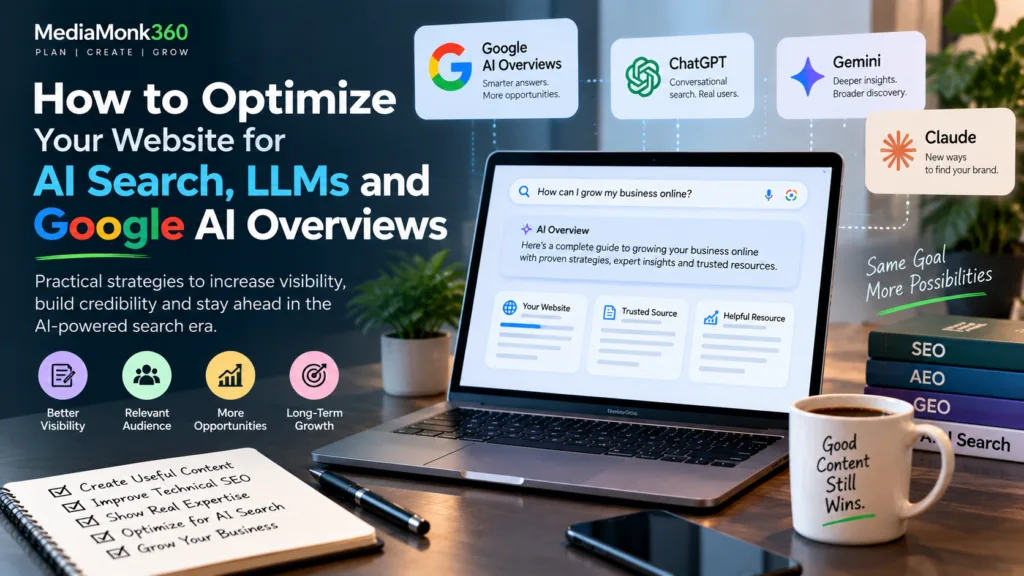
Search is becoming more conversational, more contextual and increasingly influenced by artificial intelligence.
People still use Google to find websites, products, services and information, but the way answers are presented is changing. Google now includes AI-powered experiences such as AI Overviews and AI Mode, while people are also using AI assistants and large language models to research businesses, compare options and understand complicated topics.
For website owners, this creates an important question:
How do you optimize a website when people may discover information through traditional search results as well as AI-generated answers?
The answer is not to abandon SEO or create a completely separate “AI SEO” system.
Google’s current guidance makes this particularly clear: its generative AI search features are built on core Search systems, so established SEO practices continue to matter. Google also recommends focusing on useful, original, people-first content rather than trying to manipulate AI-generated results with shortcuts.
This means businesses should think about AI search as an evolution of search visibility rather than a replacement for SEO.
What Is AI Search?
AI search refers to search experiences where artificial intelligence is used to understand a user’s query, gather relevant information and provide a more conversational or synthesized response.
Traditional search often presents a collection of webpages. AI-powered search can go further by understanding the context of a question and combining information from different sources.
For example, someone might search:
“What should a small business consider before hiring an SEO agency?”
A traditional search experience may show articles, agency websites and guides.
An AI-powered search experience may provide a summarized answer and include links to sources that support different parts of the response.
This means a business website needs to do more than simply contain keywords. Its information needs to be clear, accessible, useful and trustworthy enough to be considered relevant to the subject.
How Google AI Overviews Change Search Visibility
Google AI Overviews are designed to provide users with an AI-generated overview of certain search topics while still connecting users with relevant web sources.
Google explains that its generative AI features use information retrieved from its Search index. Its systems can use techniques such as retrieval-augmented generation and query fan-out to gather relevant information for a response.
For website owners, this reinforces an important principle.
Your website still needs to be discoverable and eligible for Google Search.
If important content cannot be crawled, indexed or understood, it becomes much harder for that information to contribute to search visibility.
AI search therefore does not remove the need for technical SEO. In many ways, it makes having a clear and accessible website even more important.
Start With Strong SEO Foundations
The first step toward AI search optimization is surprisingly familiar: make sure your basic SEO is strong.
Your website should have a logical structure, crawlable pages, clear navigation, relevant internal links and content that satisfies search intent.
Important pages should be accessible to search engines and users.
The site should also work properly on mobile devices, load efficiently and provide a good page experience.
Google’s current guidance specifically recommends continuing established technical SEO practices when preparing websites for generative AI search. It also notes that pages need to be indexed and eligible to appear in Google Search in order to be considered for generative AI features.
This is why businesses should not start by looking for an AI-specific trick.
Start with the website itself.
Create Content That Goes Beyond Basic Information
One of the strongest recommendations in Google’s current AI-search guidance is to create valuable, non-commodity content.
This distinction matters.
Suppose ten websites have already published articles explaining “What is digital marketing?”
Publishing an eleventh article that says essentially the same thing may provide very little additional value.
A stronger article might explain how digital marketing works for a specific type of business, include practical examples, discuss common mistakes or provide insights based on actual experience.
This is the difference between generic information and useful expertise.
For MediaMonk360, for example, an article about Google Ads could become more valuable by explaining how a small Indian business should think about campaign objectives, landing pages, lead quality and budget allocation rather than simply defining PPC advertising.
Google’s guidance specifically encourages unique perspectives, first-hand experience and content that provides value beyond information that could easily be reproduced elsewhere.
Write for People First
AI search optimization should never turn an article into something that feels unnatural.
Readers should be able to understand the subject without encountering repetitive keywords, awkward phrases or paragraphs written purely to satisfy a search system.
Use descriptive headings.
Keep paragraphs focused.
Explain technical concepts in straightforward language.
Use examples where they genuinely improve understanding.
Most importantly, make sure the article actually answers the question that brought the visitor to the page.
Google also states that there is no ideal page length for generative AI search. Content should be written according to the subject and audience rather than artificially expanded or broken into tiny sections for AI systems.
Understand Search Intent More Carefully
AI search makes search intent even more important because users are increasingly asking complete questions instead of typing short keyword combinations.
Consider the difference between:
“SEO agency”
and:
“How can an SEO agency help a small business get more customers from Google?”
The first query could indicate several different intentions.
The second provides much more context.
A useful content strategy should understand what the visitor is trying to accomplish.
Someone researching a concept needs educational content.
Someone comparing solutions needs a comparison or decision-making guide.
Someone looking for a service may need a detailed service page.
Someone ready to contact a company needs a clear conversion path.
When content matches the underlying intent, it becomes more useful for both visitors and search systems.
Make Important Information Easy to Understand
A website should not make visitors work unnecessarily hard to find important information.
For example, a service page should clearly explain what the service is, who it is for, what the process involves and what the visitor should do next.
Similarly, a blog article should introduce the subject clearly and then develop the topic logically.
Use H2 and H3 headings to create a meaningful hierarchy.
Don’t create headings simply to insert keywords.
A heading should tell the reader what the next section is actually about.
This also creates a clearer information structure for systems that process webpage content.
Build Topic Depth With Internal Linking
AI search does not mean that every topic needs its own isolated article.
A stronger strategy is to build connected topic clusters.
For example, a website discussing SEO could have a main guide about SEO strategy supported by articles about technical SEO, local SEO, keyword research, internal linking, SEO measurement and SEO for small businesses.
These pages can naturally link to one another when the connection is useful.
Internal linking helps visitors discover related information and gives search engines additional context about the relationship between pages.
The key is relevance.
Don’t add internal links simply because you need to reach a certain number.
Link when the additional page genuinely helps the reader continue their research.
Make Your Website Technically Accessible
Content quality is important, but technical accessibility still matters.
Google’s AI optimization guidance recommends making sure content is crawlable and that important pages can be discovered and indexed.
For JavaScript-heavy websites, Google can process JavaScript, but developers still need to follow JavaScript SEO best practices.
Semantic HTML can also help users, including people using screen readers, navigate content more effectively.
A website should also provide a good experience across devices, minimize unnecessary latency and make the primary content easy to distinguish from other elements on the page.
For businesses, this means AI search optimization should be discussed with both the content and development teams.
A great article is not enough if the website has technical problems that prevent important information from being properly accessed.
Don’t Hide Your Expertise
A website should make it clear who is behind the information.
For a business, this means maintaining useful About, Service, Contact and other trust-building pages alongside its blog content.
If you are writing about a professional subject, demonstrate what your business actually knows about that subject.
A marketing agency should not simply publish generic definitions of SEO and Google Ads.
It can explain how it approaches campaigns, what problems businesses commonly face and how different marketing channels work together.
This creates a more credible website because the content reflects the actual business rather than existing only to attract search traffic.
First-Hand Experience Makes Content More Useful
Consider two articles about Google Ads.
One simply explains what Google Ads is using information that could be found anywhere.
The other explains how businesses should evaluate campaign goals, landing pages, lead quality and conversion tracking based on practical experience.
The second article has a stronger reason to exist.
This is exactly the kind of distinction Google highlights when discussing non-commodity content and first-hand perspectives for generative AI search.
Do You Need Special AI SEO Markup?
This is one of the biggest misconceptions surrounding AI search.
There is currently no special Google schema that guarantees inclusion in AI Overviews or AI Mode.
Google’s current guidance also says that websites do not need to create special machine-readable files, AI-specific markup or llms.txt files to appear in Google Search or its generative AI features. Google Search ignores llms.txt for its search systems.
That does not make structured data useless.
Structured data can still be valuable as part of an overall SEO strategy and can help eligible pages qualify for relevant search features.
The important distinction is that structured data should describe content that actually exists on the page. It should not be treated as a shortcut for gaining AI visibility.
Should You Optimize Content Specifically for LLMs?
It is useful to think about how large language models understand information, but businesses should be careful not to overcomplicate this.
You do not need to rewrite every sentence using artificial language designed to “sound good to AI.”
You also don’t need to insert every possible variation of a keyword.
Modern search systems can understand related concepts, synonyms and context.
A better approach is to explain the subject thoroughly and naturally.
If an article is about “technical SEO,” for example, it can naturally discuss crawling, indexing, website architecture, canonical URLs, page performance and internal linking because these concepts are genuinely connected to the topic.
That produces semantic depth without keyword stuffing.
Google’s current guidance specifically says there is no need to rewrite content solely for AI systems or target every possible long-tail variation.
Don’t Create Hundreds of Pages for AI Search
The growing interest in AI search has created a temptation to publish large numbers of pages targeting every possible question.
That can be a serious mistake.
Google’s spam policies describe scaled content abuse as creating many pages primarily to manipulate search rankings rather than help users. This applies regardless of how the content was produced, including cases where generative AI is used to produce large amounts of low-value material.
The same principle applies to AI search.
Creating dozens of nearly identical pages for slightly different versions of a question is not a sustainable optimization strategy.
It is better to create fewer, stronger resources that genuinely cover the subject.
Use Images and Other Media Where They Add Value
AI search is not limited to text.
Google’s current guidance notes that generative AI search features can surface relevant images and videos, creating additional opportunities for websites to be discovered.
That means businesses should use visual content when it genuinely improves the page.
A tutorial might benefit from screenshots.
A product page might need original product photography.
A marketing guide might benefit from a useful diagram or explanatory graphic.
The important word is relevant.
Adding decorative stock images simply to increase the number of images on a page does not automatically improve its value.
Optimize Local Business Information
For businesses that operate in specific locations, local information can also contribute to visibility.
Google notes that generative AI experiences can include information about local businesses, products and services. Maintaining accurate business information through tools such as Google Business Profile can therefore be useful for local search visibility.
For a local agency, this means your website should clearly communicate where you operate, what services you provide and how customers can contact you.
Your website and Business Profile should also present consistent and accurate information.
How to Measure AI Search Visibility
AI search optimization should be measured rather than treated as a theoretical exercise.
Google’s Search Console now provides a Generative AI performance report that can help website owners understand how their content is being discovered through generative AI features on Google Search and Discover.
Traditional Search Console data remains useful too.
Look at impressions, clicks, click-through rates, queries and the pages receiving visibility.
Then connect those metrics with business outcomes.
For a service business, an increase in relevant enquiries may be much more valuable than an increase in impressions alone.
The real objective is not simply to appear in an AI-generated answer.
It is to attract the right audience and give them a reason to visit, trust and engage with your business.
A Practical AI Search Optimization Strategy
A sensible strategy can begin with your existing website.
First, identify your most important services, products and topics. Then understand the questions customers actually ask around those subjects.
Review your existing pages and identify areas where the content is generic, outdated or incomplete.
Improve those pages with clearer explanations, stronger examples, original insights and relevant internal links.
At the same time, review your technical SEO. Make sure important pages can be crawled and indexed, the website works properly on mobile devices and your internal structure makes sense.
Then create supporting content around important topics rather than publishing random articles.
Finally, use Search Console and analytics to understand what is gaining visibility and whether that visibility is contributing to meaningful business outcomes.
This approach creates a foundation that can support traditional search as well as emerging AI-powered experiences.
What Businesses Should Focus on in 2026
The biggest change in AI search is not that businesses suddenly need a completely new form of SEO.
The bigger change is that search is becoming better at understanding context, combining information and answering more complex questions.
That makes shallow content less useful.
A website that simply repeats common information may struggle to stand out.
A website that demonstrates real expertise, provides useful information, maintains a strong technical foundation and clearly communicates what the business does has a much stronger foundation.
Google’s own guidance for generative AI search emphasizes this approach: continue using SEO fundamentals, create unique and useful content, focus on people rather than search-engine manipulation and use Search Console to monitor performance.
Final Thoughts
Optimizing a website for AI search, LLMs and Google AI Overviews is not about discovering a secret formula.
It is about building a website that deserves to be discovered.
Start with strong technical SEO. Create content that answers real questions. Go beyond information that can be copied from dozens of other websites. Demonstrate first-hand knowledge where possible and connect related pages through useful internal links.
Don’t waste time creating unnecessary AI-specific files or stuffing pages with keyword variations.
Most importantly, don’t create content simply because you think an AI system might reference it.
Create it because your audience needs it.
As search continues to evolve, businesses that build useful, technically accessible and trustworthy websites will be in a much stronger position to adapt.
The future of search may be powered by AI, but the foundation is still valuable information created for real people.
Questions, Clearly Answered.
Get straightforward answers to common questions around SEO, advertising, social media, content and digital growth.
Results depend on the channel, competition, website condition, budget and business objectives. SEO generally needs consistent work over time, while paid campaigns can generate measurable data much faster.
SEO helps businesses build organic visibility, useful content assets and sustainable search presence. It also supports visibility across modern search experiences and AI-powered discovery.
SEO focuses on organic visibility, while Google Ads uses paid placements to reach selected searches and audiences. Businesses may use either channel or combine both depending on their goals and timelines.
Yes. Social media can support awareness, engagement, lead generation and remarketing when content, targeting, creative and conversion paths are aligned.
GEO refers to Generative Engine Optimization and AEO refers to Answer Engine Optimization. Both focus on making information easier for modern search and answer systems to understand and surface.
The decision depends on business objectives, competition, budget, sales cycle, audience and desired timeline. Paid campaigns can provide faster testing, while SEO builds organic visibility over time.
Explore More Insights
Practical insights on SEO, advertising, content, social media and digital business growth.
Google Ads vs SEO: Which One Should Your Business Invest In First?
Google Ads for Small Businesses: How to Start Without Wasting Your Budget
GEO vs AEO vs SEO: What Businesses Need to Know About AI Search
How to Build an SEO Strategy That Actually Brings Business Leads
SEO for Small Businesses in India: A Practical Guide to Getting More Organic Traffic
Digital Services Built Around Growth
From websites and apps to search, paid media, content and creative — everything you need to build a stronger digital presence.
Web Development
Fast, responsive and conversion-focused websites.
App Development
Modern mobile apps designed around your users.
SEO / GEO / AEO
Search visibility across Google and AI discovery.
Google Ads / PPC
Targeted campaigns focused on qualified traffic.
Meta Ads
Creative campaigns built for reach and leads.
Social Media Management
Consistent social content that builds your brand.
Content Writing
Useful, search-friendly content that earns attention.
Graphic Design
Clean visual systems for stronger brand communication.
Ready to Turn Your Digital Presence Into Growth?
Let's create a focused digital strategy for your business and turn ideas into measurable results.
Talk to MediaMonk360