GEO vs AEO vs SEO: What Businesses Need to Know About AI Search
Search is changing faster than it has in years. People are no longer using search engines only to find a list of websites. They are asking longer questions, looking for direct answers, comparing different options and increasingly using AI-powered search experiences to understand a topic.
This shift has introduced three terms that are becoming common in digital marketing: SEO, AEO and GEO.
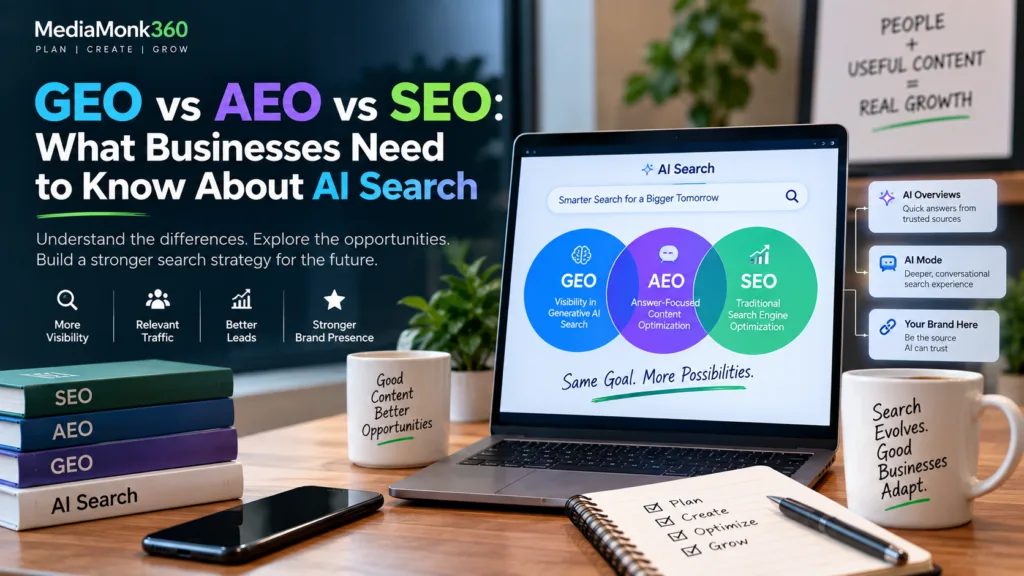
SEO stands for Search Engine Optimization, AEO stands for Answer Engine Optimization, and GEO stands for Generative Engine Optimization. Although these terms describe different areas of search optimization, they are closely connected.
For businesses, the important question is not whether they should choose SEO, AEO or GEO. The better question is how these approaches can work together to make their website more visible, useful and trustworthy across modern search experiences.
What Is SEO?
Search Engine Optimization, commonly known as SEO, is the process of improving a website so that search engines can discover, understand and rank its pages for relevant searches.
SEO covers much more than adding keywords to a page. It includes the quality and relevance of the content, website structure, internal linking, technical accessibility, mobile experience, page performance, search intent and the overall usefulness of a website.
For example, a company offering digital marketing services might want to appear when someone searches for “digital marketing agency for small businesses.” A relevant service page that clearly explains the company’s services, expertise and approach can be optimized around that search intent.
SEO therefore starts with a simple objective: helping the right people discover the right information at the right stage of their search journey.
Traditional search is still extremely important. Even though search interfaces are changing, search engines still need to discover webpages, understand their content and determine which information is relevant to a particular query.
That is why SEO remains the foundation for modern search visibility.
What Is AEO?
Answer Engine Optimization, or AEO, focuses on creating content that provides clear and useful answers to questions people are asking.
Search behavior has become increasingly conversational. Instead of searching for a short phrase such as “technical SEO,” a user may ask, “What is technical SEO and why is it important for a website?”
A page that directly explains the answer can provide a much better experience than a page that simply repeats the keyword throughout the article.
AEO is particularly relevant for informational content because people often use search engines to solve a problem, understand a concept or make a decision.
A well-structured article can introduce the answer clearly and then provide additional context, examples and explanations for readers who want to understand the subject in greater depth.
This does not mean that every article needs to be converted into a long list of questions and answers. Good AEO is still good content. The focus is simply on making important information clear, accessible and easy to understand.
What Is GEO?
Generative Engine Optimization, or GEO, is a term used to describe efforts aimed at improving the visibility and usefulness of a brand’s information in generative AI search experiences.
The traditional search experience usually gives users a collection of webpages. Generative search can instead combine information from different sources and produce a synthesized response.
For example, a user might ask an AI-powered search experience, “What should a small business look for when choosing a digital marketing agency?”
Instead of simply showing a list of agency websites, the system may provide an explanation and use information from multiple sources to build its response.
This changes the way businesses think about online visibility.
It is no longer enough to think only about ranking for individual keywords. Businesses also need to think about whether their website provides reliable, useful and distinctive information that can be understood in a broader search environment.
However, GEO should not be treated as a completely separate replacement for SEO. Google’s current guidance explains that established SEO fundamentals remain relevant to its generative AI search experiences.
That makes GEO less about finding a secret AI ranking technique and more about preparing a website for the way search is evolving.
GEO vs AEO vs SEO: What Is the Difference?
The main difference comes down to the type of search experience each concept emphasizes.
SEO is primarily concerned with improving a website’s visibility and accessibility within search engines. AEO focuses more strongly on answering specific questions clearly and efficiently. GEO considers how useful and discoverable information can be within generative AI-powered search experiences.
In reality, there is significant overlap between all three.
A well-written article can be optimized for traditional search, answer important questions and provide useful information that may be relevant to AI-powered search at the same time.
This is why businesses should avoid building three completely separate content strategies.
Instead, the strongest approach is to create one strong search strategy where SEO provides the foundation, AEO improves the clarity of answers and GEO extends the thinking toward emerging AI search experiences.
Is SEO Still Important in the Age of AI Search?
Yes, and this is one of the most important points businesses need to understand.
The growth of AI search does not mean that traditional SEO has suddenly stopped working.
Search systems still need to access webpages and understand their information. Websites still need to be technically accessible. Content still needs to satisfy user intent. Internal linking, useful page structure and clear information still matter.
Google’s guidance for AI features also points website owners toward established SEO fundamentals rather than suggesting that websites need an entirely separate technical system for AI search.
The interface may look different, but the fundamental goal remains similar: provide useful information that can be discovered, understood and trusted.
This is why businesses that already have a strong SEO foundation are in a better position to adapt as search continues to evolve.
How SEO, AEO and GEO Work Together
A business does not need to create completely separate content for each optimization approach.
Imagine a digital marketing agency publishing an article about Google Ads for small businesses.
From an SEO perspective, the article can target relevant search intent around Google Ads, PPC advertising and Google Ads for small businesses.
From an AEO perspective, the article can clearly explain questions such as how Google Ads works, how much businesses should consider spending and what factors influence campaign performance.
From a GEO perspective, the same article can provide deeper explanations, practical examples, useful comparisons and original insights instead of simply repeating generic information found across other websites.
The result is a stronger piece of content that can serve multiple search experiences without becoming artificially optimized for each one.
Create Content That Offers Real Value
One of the biggest mistakes businesses can make while preparing for AI search is focusing too heavily on producing more content.
Publishing more pages does not automatically create more authority.
The better approach is to ask what a particular piece of content contributes to the reader.
If hundreds of websites already explain the basic definition of a topic, simply rewriting the same information will not necessarily make your page valuable.
A stronger article might provide practical examples, original analysis, first-hand experience, industry-specific explanations or a clearer way of solving a problem.
This becomes especially important as search systems become better at understanding similar pieces of content.
Businesses should therefore focus less on producing content simply because a keyword exists and more on creating content because customers genuinely need that information.
Understand Search Intent Before Writing
Keywords are useful, but keywords alone do not explain why someone is searching.
Someone searching for “what is SEO” is probably trying to learn.
Someone searching for “SEO agency pricing” may be comparing options.
Someone searching for “SEO agency near me” may already be looking for a service provider.
These searches may contain related words, but the intent behind them is different.
A strong content strategy starts by understanding that intent.
Once you know what the visitor wants, you can decide whether the right format is an educational article, service page, comparison, guide or another type of content.
This is one of the areas where SEO, AEO and GEO naturally come together. Understanding what people want makes it easier to create content that answers their questions and satisfies their search journey.
Structure Your Content for People First
Good structure helps both readers and search systems understand a page.
A clear introduction should explain what the article is about. H2 headings should divide the subject into meaningful sections, while H3 headings can be used when a particular section needs additional explanation.
Paragraphs should remain focused and easy to read.
There is no need to turn every sentence into a separate bullet point or create dozens of small sections simply because an article is being optimized for AI search.
Google’s current guidance does not require websites to use a particular word count or break every topic into extremely small content blocks.
The better principle is simple: organize information in a way that makes sense to the reader.
Build Topic Authority Instead of Publishing Random Articles
A strong website usually has a relationship between its content.
For example, a digital marketing agency might publish a detailed guide about SEO for small businesses. That article can naturally connect to other useful resources covering local SEO, technical SEO, keyword research, Google Ads and SEO strategy.
These connections help visitors explore a topic instead of treating every article as an isolated page.
Over time, this creates a more useful content ecosystem.
The objective should not be to create hundreds of pages around slightly different keyword variations. It should be to build a collection of genuinely useful resources that together demonstrate knowledge of an important subject.
Make Your Business Expertise Clear
Modern search is not only about individual articles.
The wider context of the website matters.
A business website should clearly communicate what the company does, who it serves and what subjects it has experience with.
For a digital marketing agency, the service pages, company information, portfolio, case studies, contact information and educational articles should support the same overall identity.
When these elements are consistent, the website becomes a stronger representation of the business rather than simply a collection of blog posts created for search traffic.
Technical SEO Still Matters
Content quality cannot compensate for a website that search engines cannot properly access or understand.
Technical SEO remains an important part of search visibility.
A website should have a logical structure, accessible important content, sensible internal links and pages that work properly across mobile and desktop devices.
Page performance also matters because users expect websites to load quickly and work smoothly.
Similarly, canonical URLs, XML sitemaps and appropriate structured data can help search engines understand a website when implemented correctly.
There is no need to create a special technical system simply because a website wants to appear in AI search. The fundamentals still provide the foundation.
Should Businesses Create Separate GEO Content?
In most cases, there is no need to create an entirely separate article simply because the goal is GEO.
A better approach is to improve the quality of the content you are already creating.
Suppose a business has an article titled “How Much Does SEO Cost in India?”
Instead of creating another page called “SEO Cost India AI Search Guide,” the existing article can be made more useful by explaining the factors that influence pricing, different types of SEO work, what businesses should evaluate when comparing agencies and what questions they should ask before making a decision.
That content is useful to people.
It is also structured information that can be understood by search systems.
The emphasis should therefore be on improving the underlying information rather than producing pages specifically designed to manipulate AI systems.
Avoid the Biggest GEO and AEO Mistakes
One common mistake is treating GEO as a replacement for SEO.
Another is creating content primarily for AI systems instead of people.
Businesses can also run into problems when they publish large numbers of pages that provide little original value. Changing the wording of the same information and targeting slightly different keywords does not automatically create a strong content strategy.
Google’s spam policies specifically address scaled content created primarily to manipulate search rankings when it provides little or no additional value.
This is why quality matters more than volume.
A website with 30 genuinely useful articles can be far more valuable than a website with 500 repetitive pages.
How Should Businesses Measure Search Visibility?
SEO performance should not be judged by rankings alone.
Businesses should look at the complete journey from search visibility to business outcomes.
Search Console can help identify impressions, clicks, click-through rates, search queries and the pages receiving search visibility.
Analytics can then help businesses understand what visitors do after reaching the website.
For a service business, the most important outcome may ultimately be an enquiry, phone call, consultation or qualified lead rather than a particular keyword position.
Google has also introduced reporting related to generative AI search within Search Console’s broader performance reporting, giving site owners additional visibility into how their content performs as search experiences evolve.
The important point is to connect search performance with actual business objectives.
The Future of Search Is Not SEO vs GEO vs AEO
It is tempting to think that SEO belongs to the old version of search while GEO and AEO represent the future.
That comparison is too simplistic.
SEO, AEO and GEO are better understood as connected approaches to the same broader objective: helping people find and understand useful information.
SEO provides the technical and strategic foundation.
AEO encourages businesses to answer important questions clearly.
GEO brings additional attention to how information can remain useful and discoverable as generative AI becomes part of search.
The terminology may continue to evolve, but the fundamental principles are unlikely to disappear.
Businesses still need useful information. They still need technically sound websites. They still need credibility. And they still need to give customers a reason to choose them.
Final Thoughts
AI is changing the way people discover information, but businesses should not respond by abandoning the fundamentals of search optimization.
Instead, they should build websites that are genuinely useful.
Create content that answers real customer questions. Explain complicated subjects clearly. Add original experience and insight where possible. Build logical connections between related pages and make sure the technical foundation of the website is strong.
That approach supports SEO today while also preparing a business for AEO and GEO as search continues to evolve.
The goal is not to find a shortcut into an AI-generated answer.
The goal is to become a source worth finding, understanding and trusting.
Questions, Clearly Answered.
Get straightforward answers to common questions around SEO, advertising, social media, content and digital growth.
Results depend on the channel, competition, website condition, budget and business objectives. SEO generally needs consistent work over time, while paid campaigns can generate measurable data much faster.
SEO helps businesses build organic visibility, useful content assets and sustainable search presence. It also supports visibility across modern search experiences and AI-powered discovery.
SEO focuses on organic visibility, while Google Ads uses paid placements to reach selected searches and audiences. Businesses may use either channel or combine both depending on their goals and timelines.
Yes. Social media can support awareness, engagement, lead generation and remarketing when content, targeting, creative and conversion paths are aligned.
GEO refers to Generative Engine Optimization and AEO refers to Answer Engine Optimization. Both focus on making information easier for modern search and answer systems to understand and surface.
The decision depends on business objectives, competition, budget, sales cycle, audience and desired timeline. Paid campaigns can provide faster testing, while SEO builds organic visibility over time.
Explore More Insights
Practical insights on SEO, advertising, content, social media and digital business growth.
Google Ads vs SEO: Which One Should Your Business Invest In First?
Google Ads for Small Businesses: How to Start Without Wasting Your Budget
How to Optimize Your Website for AI Search, LLMs and Google AI Overviews
How to Build an SEO Strategy That Actually Brings Business Leads
SEO for Small Businesses in India: A Practical Guide to Getting More Organic Traffic
Digital Services Built Around Growth
From websites and apps to search, paid media, content and creative — everything you need to build a stronger digital presence.
Web Development
Fast, responsive and conversion-focused websites.
App Development
Modern mobile apps designed around your users.
SEO / GEO / AEO
Search visibility across Google and AI discovery.
Google Ads / PPC
Targeted campaigns focused on qualified traffic.
Meta Ads
Creative campaigns built for reach and leads.
Social Media Management
Consistent social content that builds your brand.
Content Writing
Useful, search-friendly content that earns attention.
Graphic Design
Clean visual systems for stronger brand communication.
Ready to Turn Your Digital Presence Into Growth?
Let's create a focused digital strategy for your business and turn ideas into measurable results.
Talk to MediaMonk360