How to Build an SEO Strategy That Actually Brings Business Leads
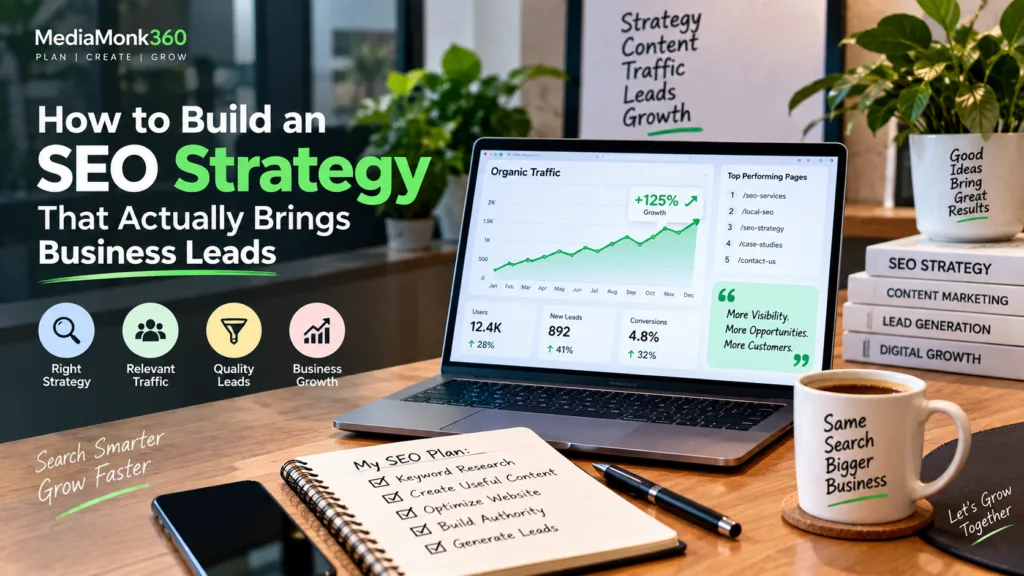
Getting more website traffic sounds like a good SEO goal. But if that traffic never turns into enquiries, calls, bookings or sales, it is difficult to call the strategy successful.
This is a common problem for businesses investing in SEO. A website may start receiving more impressions and visitors, yet the number of genuine enquiries remains almost unchanged.
The reason is usually simple: traffic and leads are not the same thing.
A good SEO strategy should bring your business in front of people who have a real connection with the products or services you offer. It should answer their questions, build confidence and make the next step easy.
That means SEO needs to be planned around the customer journey, not just a list of keywords.
In this guide, we will look at how to build an SEO strategy that connects search visibility with actual business opportunities.
What Is a Lead-Generating SEO Strategy?
A lead-generating SEO strategy is a search optimization plan designed to attract people who are likely to become customers.
The difference is in the intent behind the traffic.
Imagine a company that provides website development services. Ranking for a broad search such as “website” might generate visibility, but it does not necessarily bring people who need development services.
A search such as “website development company for small business” has a much clearer commercial purpose.
The second search may have a smaller audience, but the people behind it can be considerably more relevant to the business.
This is why a strong SEO strategy starts with understanding:
- Who you want to attract
- What they are searching for
- What problem they are trying to solve
- What information they need before contacting you
- What action you want them to take
Start With the Business Goal, Not the Keyword
Before researching keywords, decide what SEO is supposed to accomplish.
For one business, the goal may be generating consultation requests.
For another, it may be product sales.
A local business may want phone calls or directions.
A B2B company may want qualified enquiries from decision-makers.
These goals influence the entire SEO strategy.
Define What a Valuable Lead Means
Not every form submission is necessarily a good lead.
For example, a digital marketing agency might receive enquiries from people looking for extremely cheap services, students asking for advice or businesses outside its service area.
Those enquiries may increase the lead count without improving revenue.
A better approach is to define what a qualified lead looks like.
Consider factors such as:
- Service required
- Location
- Business size
- Budget
- Project type
- Purchase timeline
- Decision-making authority
Once you understand the type of lead you want, keyword research and content planning become much more focused.
Map Keywords to Search Intent
Keyword research should not stop at finding phrases with high search volume.
You need to understand why someone is searching.
Search intent generally falls into a few useful groups.
Informational Intent
The person wants to learn something.
Examples:
- How does SEO work?
- What is technical SEO?
- How long does SEO take?
These searches are useful for educational content and early-stage awareness.
Commercial Investigation
The person is researching options before making a decision.
Examples:
- Best SEO agency for small business
- SEO services pricing
- SEO agency vs freelancer
These searches can be valuable because the person is getting closer to a purchase decision.
Transactional or Service Intent
The person is looking for a solution.
Examples:
- SEO agency in Nagpur
- local SEO services
- ecommerce SEO company
- Google Ads management service
These pages often have a stronger connection to lead generation because the search already reflects a business need.
Navigational Intent
The person is trying to find a particular website, brand or business.
For a growth-focused SEO strategy, informational, commercial and service-oriented searches often provide more opportunities to reach potential customers who are still evaluating solutions.
Build a Keyword Map Instead of One Giant Keyword List
Once you understand search intent, organise your keywords according to pages.
For example, an SEO agency could create a structure like:
Service page:
“SEO Services”
Supporting service page:
“Local SEO Services”
Supporting article:
“How Local SEO Helps Small Businesses”
Supporting article:
“Google Business Profile Optimization Guide”
Supporting article:
“How to Choose an SEO Agency”
This is more useful than creating dozens of unrelated articles around similar phrases.
Each page should have a clear purpose.
The service page can focus on conversion.
The supporting articles can answer questions and build topical relevance.
Together, they create a path from search discovery to business enquiry.
Create Landing Pages for High-Intent Searches
One of the biggest mistakes in SEO lead generation is sending every searcher to the homepage.
Your homepage has an important role, but it cannot answer every specific commercial need.
If you provide several services, create dedicated pages for important services.
For example:
- SEO Services
- Google Ads Management
- Meta Ads
- Social Media Management
- Web Development
- Content Writing
Each page should explain what the service includes, who it is suitable for, how the process works and what the visitor should do next.
Make the Page Answer the Buyer’s Questions
Before contacting a business, people often want to know:
What exactly do you provide?
Who is the service for?
How does the process work?
What kind of business can benefit?
What information do you need from the client?
How can someone get started?
Answering these questions clearly can reduce uncertainty and make a visitor more comfortable taking the next step.
Create Content Around the Customer Journey
Not everyone searching for your topic is ready to buy.
Someone discovering SEO for the first time is in a different position from someone comparing SEO agencies.
Your content should reflect that.
Top-of-Funnel Content
These articles introduce a problem or topic.
Examples:
- What Is SEO?
- How Does Local SEO Work?
- Why Does Website Speed Matter?
Middle-of-Funnel Content
These articles help people evaluate solutions.
Examples:
- SEO vs Google Ads
- How to Choose an SEO Agency
- What Should an SEO Strategy Include?
Bottom-of-Funnel Content
These pages target people who are closer to taking action.
Examples:
- SEO Services for Small Businesses
- Local SEO Services
- SEO Agency in Nagpur
A strong strategy connects these stages rather than publishing only informational articles.
Make Every Article Lead Somewhere Useful
A blog post should not become a dead end.
If someone reads an article about local SEO, give them a logical next step.
For example:
Article:
“How Local SEO Helps Small Businesses”
Relevant internal links:
“Local SEO Services”
“Google Business Profile Guide”
“SEO Strategy for Small Businesses”
“Contact Our SEO Team”
The links should make sense in context.
Avoid adding unrelated links just to increase the number of internal links on a page.
Improve Conversion Paths on Organic Landing Pages
Getting a visitor to your website is only one part of the process.
The visitor also needs a clear next step.
Depending on your business, that could be:
- Request a consultation
- Call the business
- Send an enquiry
- Book an appointment
- Request a quotation
- Start a WhatsApp conversation
- Purchase a product
The call to action should match the visitor’s intent.
Someone reading an introductory SEO guide may not be ready for a hard sales pitch.
Someone visiting a service page may be much closer to making contact.
Keep Forms Simple
Long forms can create unnecessary friction.
Only ask for information you actually need at the first stage.
For a basic service enquiry, fields such as name, business name, phone number, email and requirement may be enough.
You can collect additional information later when necessary.
Use Local SEO If Your Business Serves a Location
For businesses serving specific cities or regions, local SEO can become an important part of lead generation.
Google explains that local results are mainly influenced by relevance, distance and prominence. Complete and accurate Business Profile information helps Google understand what the business offers and where it operates. :contentReference[oaicite:2]{index=2}
That means local SEO should not simply mean adding a city name repeatedly to every page.
Instead, make your location and service information genuinely useful.
Strengthen Your Google Business Profile
Keep important information accurate, including:
- Business category
- Address
- Phone number
- Website
- Opening hours
- Services
- Photos
Respond to genuine customer reviews and keep the profile information up to date.
Google also notes that reviews, links and other information across the web can contribute to prominence. :contentReference[oaicite:3]{index=3}
Build Useful Local Pages
If you genuinely serve different locations, location-specific pages can help explain what you offer in those markets.
But each page should have a real purpose.
Changing only the city name on identical pages creates a poor user experience and does not give visitors much additional value.
Improve the Pages Already Getting Impressions
SEO is not always about publishing another article.
Sometimes the best opportunity is already sitting inside your website.
Google Search Console can show the queries, pages, clicks, impressions, CTR and average position associated with your Google Search performance. :contentReference[oaicite:4]{index=4}
Look for pages that receive:
- High impressions but few clicks
- Relevant queries but weak rankings
- Good rankings but poor conversion
- Traffic from unexpected searches
High Impressions and Low CTR
If a page appears frequently but receives relatively few clicks, review whether the title and description accurately represent the page.
Google specifically recommends using Search Console to identify pages with low CTR and reviewing titles and snippets where appropriate. :contentReference[oaicite:5]{index=5}
Relevant Traffic With No Leads
This is a different problem.
If visitors are genuinely relevant but do not enquire, look beyond rankings.
Check:
- Is the service clearly explained?
- Is the page trustworthy?
- Is the CTA visible?
- Is the contact process easy?
- Does the page answer important objections?
- Is the offer clear?
More traffic will not necessarily solve a conversion problem.
Measure SEO by Leads, Not Just Rankings
Rankings are useful for understanding search visibility, but they should not become the final business metric.
Track the journey from search to enquiry.
A simple measurement system can include:
Search impressions → clicks → relevant visitors → enquiries → qualified leads → customers
Search Console can help with the first part of that journey by showing search queries, impressions, clicks, CTR and page-level performance. :contentReference[oaicite:6]{index=6}
Your analytics or CRM system can then help connect website activity with enquiries and sales.
This distinction matters.
A page that brings 1,000 irrelevant visitors may be less valuable than a page that brings 50 people who are actively looking for the service you provide.
Build Topic Clusters Around Your Core Services
Once the basic website is in place, build supporting content around important commercial topics.
For example, an SEO agency could build a cluster around SEO:
Core service:
SEO Services
Supporting topics:
- SEO strategy
- Local SEO
- Technical SEO
- Keyword research
- On-page SEO
- SEO content strategy
- SEO reporting
- SEO for small businesses
These pages can link naturally to one another where useful.
This helps users explore the subject without having to return to Google after every question.
Keep Improving Based on Real Search Data
An SEO strategy should not be treated as a document that gets created once and forgotten.
Search behaviour changes.
Your audience may begin using different terms.
New competitors may enter the market.
Some pages may perform better than expected.
Search Console’s query and page data can reveal these changes and help identify new content or optimization opportunities. Google recommends using query and page performance data to understand what is working and where improvements may be possible. :contentReference[oaicite:7]{index=7}
This creates a useful cycle:
Research → Create → Publish → Measure → Improve → Expand
That is much more sustainable than publishing a large number of articles and never reviewing them.
A Practical SEO Lead Generation Framework
If you are starting an SEO strategy today, keep the first phase simple.
Step 1: Define Your Ideal Customer
Understand who you want to attract and what makes a lead valuable.
Step 2: Identify Commercial Problems
Find the products, services and problems people search for before contacting a business.
Step 3: Map Search Intent
Separate informational searches from commercial and service-oriented searches.
Step 4: Build the Right Pages
Create strong service, location and supporting content pages instead of sending every visitor to the homepage.
Step 5: Connect the Content
Use relevant internal links to create a clear journey between educational content and commercial pages.
Step 6: Make Conversion Easy
Give visitors a clear and appropriate way to enquire, call, book or purchase.
Step 7: Measure Real Performance
Track impressions, clicks, relevant traffic, enquiries and qualified leads.
Step 8: Improve What Already Works
Update pages based on real search queries and user behaviour before constantly creating new content.
Common SEO Mistakes That Can Reduce Lead Quality
A few SEO habits can create activity without creating meaningful business growth.
Chasing Only High-Volume Keywords
A large search volume does not automatically mean strong commercial value.
Publishing Content Without a Business Purpose
Every article should answer a useful question and fit somewhere within your broader website strategy.
Sending Every Visitor to the Homepage
Relevant visitors deserve a relevant landing page.
Ignoring Conversion
SEO and conversion optimization should work together.
Measuring Only Keyword Rankings
Ranking improvements are useful, but the business ultimately needs relevant visitors and opportunities.
Expecting Immediate Results
SEO requires testing, measurement and iteration. There is no reliable formula that guarantees a specific ranking or number of leads within a fixed period.
Final Thoughts
An SEO strategy that generates business leads is not built around traffic alone.
It starts with understanding the customer, identifying useful search opportunities and creating pages that match the intent behind those searches.
From there, the website needs to guide visitors naturally from information to action.
That means strong service pages, useful content, relevant internal links, local visibility where appropriate and a clear conversion path.
Most importantly, measure what happens after the click.
If a page receives impressions but no clicks, improve its search presentation.
If it receives clicks but no enquiries, examine the page and conversion experience.
If it generates qualified leads, understand why it works and build more content around that opportunity.
SEO becomes much more valuable when it stops being a race for rankings and becomes a system for connecting the right people with the right business at the right moment.
Questions, Clearly Answered.
Get straightforward answers to common questions around SEO, advertising, social media, content and digital growth.
Results depend on the channel, competition, website condition, budget and business objectives. SEO generally needs consistent work over time, while paid campaigns can generate measurable data much faster.
SEO helps businesses build organic visibility, useful content assets and sustainable search presence. It also supports visibility across modern search experiences and AI-powered discovery.
SEO focuses on organic visibility, while Google Ads uses paid placements to reach selected searches and audiences. Businesses may use either channel or combine both depending on their goals and timelines.
Yes. Social media can support awareness, engagement, lead generation and remarketing when content, targeting, creative and conversion paths are aligned.
GEO refers to Generative Engine Optimization and AEO refers to Answer Engine Optimization. Both focus on making information easier for modern search and answer systems to understand and surface.
The decision depends on business objectives, competition, budget, sales cycle, audience and desired timeline. Paid campaigns can provide faster testing, while SEO builds organic visibility over time.
Explore More Insights
Practical insights on SEO, advertising, content, social media and digital business growth.
Google Ads vs SEO: Which One Should Your Business Invest In First?
Google Ads for Small Businesses: How to Start Without Wasting Your Budget
How to Optimize Your Website for AI Search, LLMs and Google AI Overviews
GEO vs AEO vs SEO: What Businesses Need to Know About AI Search
SEO for Small Businesses in India: A Practical Guide to Getting More Organic Traffic
Digital Services Built Around Growth
From websites and apps to search, paid media, content and creative — everything you need to build a stronger digital presence.
Web Development
Fast, responsive and conversion-focused websites.
App Development
Modern mobile apps designed around your users.
SEO / GEO / AEO
Search visibility across Google and AI discovery.
Google Ads / PPC
Targeted campaigns focused on qualified traffic.
Meta Ads
Creative campaigns built for reach and leads.
Social Media Management
Consistent social content that builds your brand.
Content Writing
Useful, search-friendly content that earns attention.
Graphic Design
Clean visual systems for stronger brand communication.
Ready to Turn Your Digital Presence Into Growth?
Let's create a focused digital strategy for your business and turn ideas into measurable results.
Talk to MediaMonk360